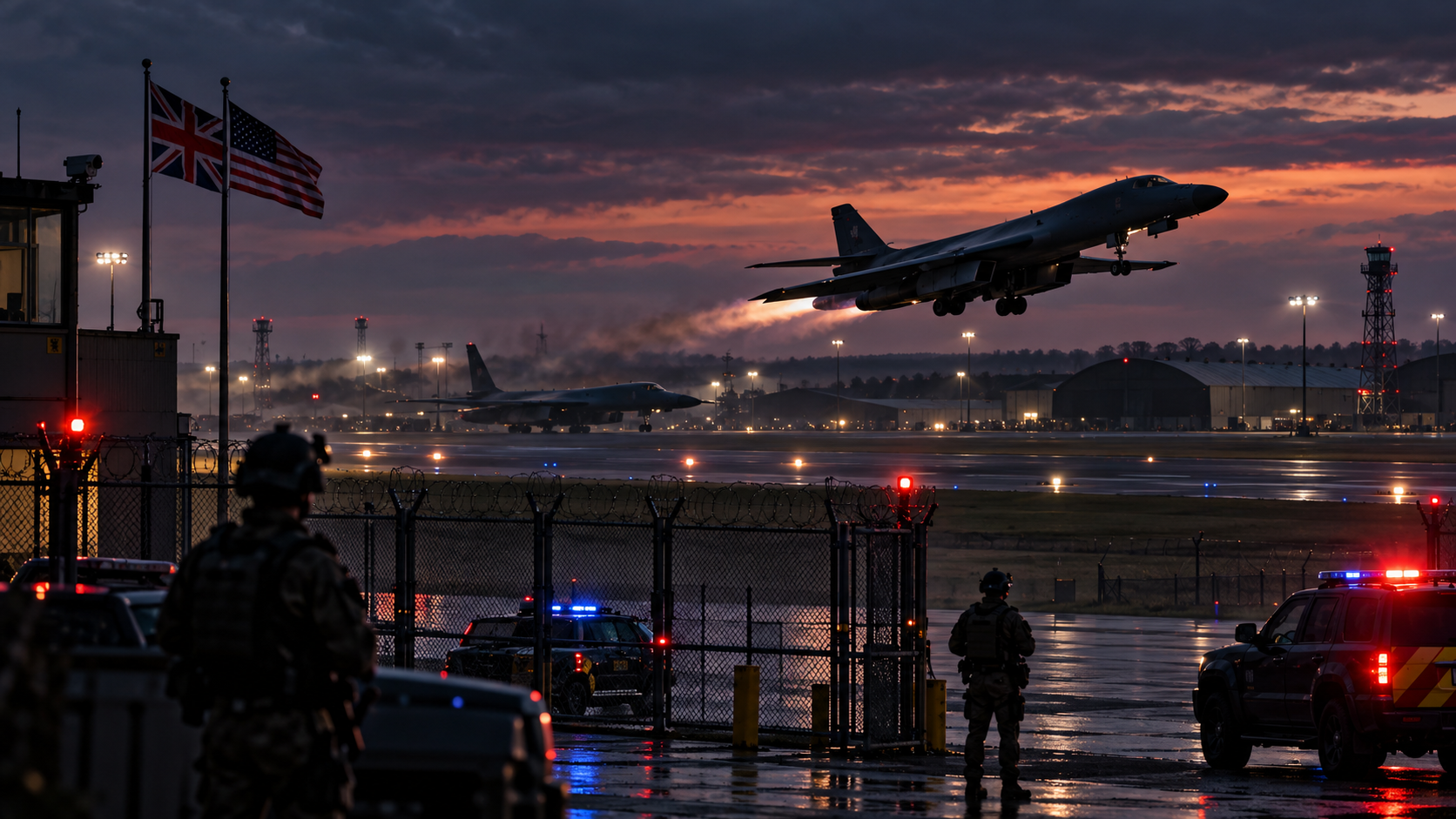
When American bombers scramble out of a host-nation base faster than the tankers can catch them, the problem is not weather or scheduling. It is trust.
On October 4, the United States pulled every B-1 Lancer still at RAF Fairford back to home stations in the continental United States. Open-source tracking and Pentagon statements confirm the departure was rapid, roughly a dozen aircraft gone in a single day after months of forward basing that shortened the flight time into the Middle East. U.S. officials told reporters the move followed fresh threat information tied to an Iran-linked plot against the base. British authorities had already declared a major incident on September 27 after masked men and three vans appeared near the perimeter, forcing the evacuation of dozens of nearby homes. Petrol was recovered. No completed devices were found. Five British men in their early twenties, arrested on explosives and terrorism suspicions, were released on bail within roughly a day under “stringent conditions.” A dual British-Iranian national was later arrested in London. Prime Minister Andy Burnham has said there are strong indications Iran played a part. Downing Street now insists the base is safe.
That sequence is not an intelligence success. It is a host-nation failure that put U.S. combat aircraft and crews inside the blast radius of someone else’s political and policing choices.
I spent more than three decades in uniform, including time as a bomb-disposal technician, a B-1 squadron commander, a wing commander, and a Joint Staff officer. Forward basing only works when the host can actually secure the ramp, the perimeter, and the approaches. Fairford has been a useful piece of concrete for American bombers for decades precisely because Britain was supposed to be the reliable partner. The recent record undercuts that assumption. Suspects walked. Homes were emptied. Aircraft left in a hurry that aircraft spotters and U.S. officials both described as driven by urgency, not routine rotation. President Trump publicly said he would not have released the men. That is not alliance friction. That is a commander protecting the force when the local security architecture cannot.
Five Eyes was built on the premise that the United States, the United Kingdom, Canada, Australia, and New Zealand share both secrets and the will to act on them. Intelligence sharing is not a sentiment. It is a vulnerability exchange. When one partner’s counter-terror apparatus treats a suspected plot against American strategic bombers as a bail matter, the other partners have to ask what else is being handled the same way, and what is being passed across the wire. Re-evaluation is not abandonment. It is the minimum duty of a government that still fields the bombers, the tankers, and the crews. Access, basing rights, and real-time feeds should be conditioned on demonstrated performance, not historical nostalgia.
Britain remains a nuclear power, a permanent member of the Security Council, and a country with capable special forces and signals talent. None of that erases the operational fact that U.S. aircraft were judged safer over the Atlantic than on a Gloucestershire ramp after an Iran-related scare. Allies who cannot or will not lock down the ground their partners use for strike operations force those partners to carry the risk alone. We have done that before. We should not pretend the cost is zero.
The aircraft are home. The questions are not. If Five Eyes cannot guarantee that American bombers parked on allied concrete are safer than they would be in South Dakota, then the arrangement needs a hard look, starting with who gets the keys, who gets the warnings, and who gets held when the vans show up at the fence.
