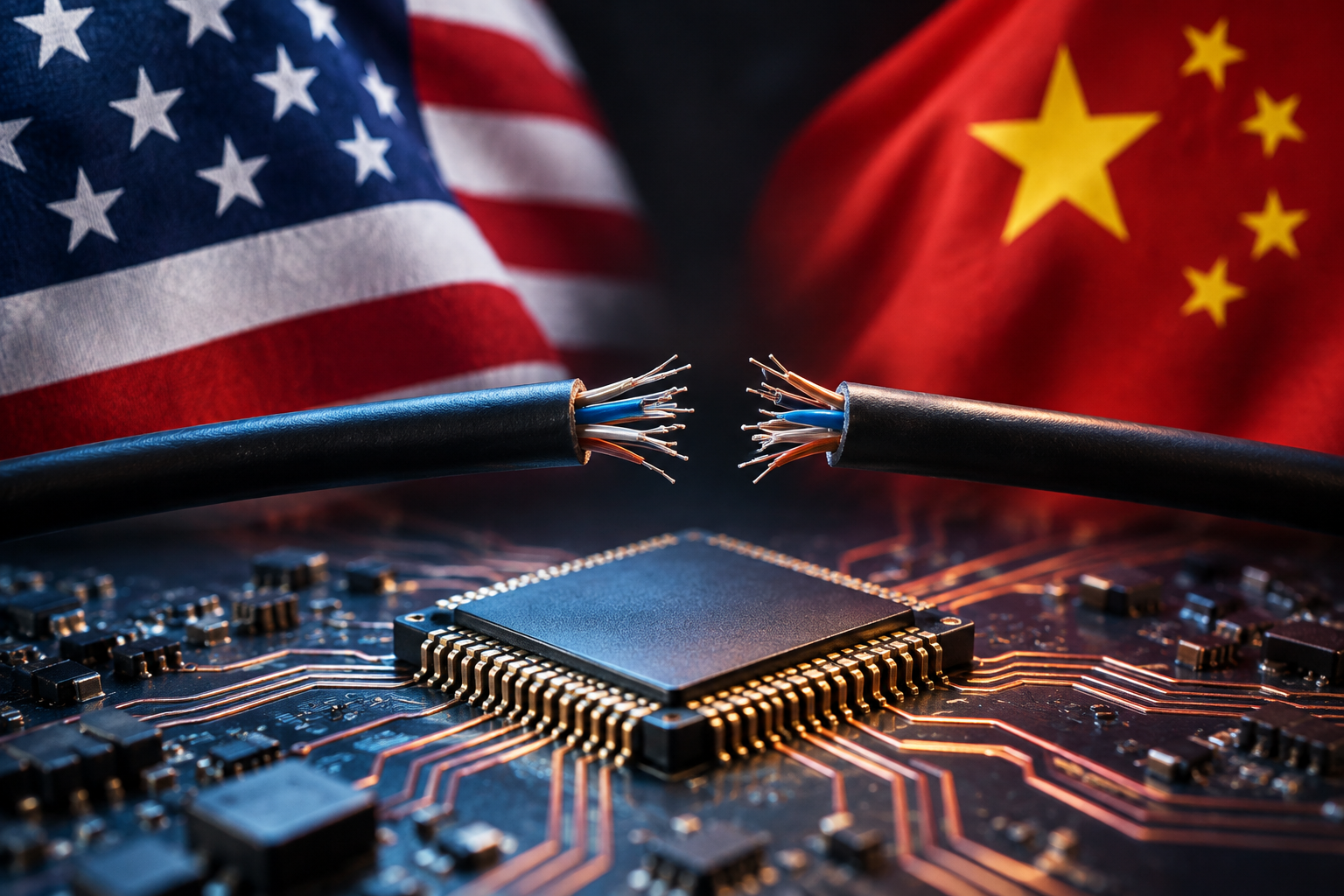
Jensen Huang stepped down as Nvidia's chief executive on Thursday, days after news reports described an affair with an executive at a Singapore company whom U.S. authorities suspect of spying for Beijing. The internet has spent a week on the romance. Desmond Shum thinks everyone is watching the wrong thing, and he is right.
Shum spent more than two decades doing business in China, by his own account "at the intersection of private enterprise, finance, and Communist Party politics." In a Substack essay published Tuesday, he lays out what the spy story misses. The woman at the center of it, Alice Huang, had a documented career in Shanghai's capital markets built on intermediaries and layered ownership, the kind of structures that separate the names on the paperwork from the people with the money. Shum calls her a likely qian ke, a commercial fixer, and possibly a bai shou tao, a "white glove" who fronts for principals who prefer to stay out of sight.
Then she became the public face of Megaspeed, a Singapore company that, Shum writes, reportedly bought about $4.8 billion worth of Nvidia equipment. Citing corporate filings reviewed by Reuters, he notes Megaspeed held about $33 million in assets at the end of 2023 and about $3 billion a year later. A short-seller report he cites traced roughly $4.1 billion in prepayments to a Singapore firm reportedly controlled by Alibaba. And on Nov. 10, he notes, The Information reported that Huang and her associates helped move at least $7.5 billion in Nvidia chip shipments to Chinese firms through companies in China and Singapore.
The line that should end the debate
Shum is careful. He does not claim to know whether she worked for China's Ministry of State Security, and he says American authorities may have evidence that has not been made public. His point is bigger than her. "A commercially motivated intermediary can accomplish what Beijing wants without ever receiving an order from the Ministry of State Security," he writes. Advanced chips are among Beijing's highest priorities, and "Beijing benefits regardless of whether the people arranging those transactions are formally working for its intelligence services."
That sentence is the whole case for decoupling. As long as American firms sell into the Chinese system, Chinese money will find a front company, a Malaysian data center or a Singapore shell to get what it wants. You cannot export-control your way out of a relationship designed to route around export controls. You have to end the relationship.
Trump gave the order. Commerce stalled.
President Trump understands this. Axios reported this week that he approved action against suspected Nvidia chip diversion in May, again in August, and a third time on Thursday, Nov. 5, after Secretary of War Pete Hegseth, Secretary of State Marco Rubio, Treasury Secretary Scott Bessent and Trade Representative Jamieson Greer made the case together in the Situation Room. "Let's get it done," the President said, according to Axios.
According to the same report, Commerce Secretary Howard Lutnick was the lone holdout, warning the controls "will start a trade war with China," and by Axios's account the controls still had not been put in place. The Commerce Department disputed parts of that account. NBC News separately reported that the Justice Department took over the Megaspeed inquiry and asked Commerce to pause its part after an Nvidia representative contacted Commerce investigators.
The answer the President's team gave Lutnick, per Axios, is the right one: "China is already doing to us what Lutnick warned would happen."
Strategic was the start. Total is the goal.
In May 2025 I wrote that the President's second-term agenda was "focused on strategic decoupling," which I described as "cutting the cord on Chinese control, before it's too late." I pointed to Chinese payment terminals in American stores, Chinese purchases of farmland near our bases, and our dependence on Chinese drug ingredients. Eighteen months later, the Nvidia affair shows what "strategic" leaves out. Every sector we leave open becomes the back door for the sectors we closed.
I have owned and operated my own company. Every owner learns to ask who is actually paying the bill. Washington has spent too long refusing to ask that question about China.
Total decoupling means no advanced American chips, chipmaking tools or AI computing capacity sold to China, whether directly, through a fixer or rented from an offshore data center. That includes ending the arrangement that lets Nvidia sell its H200 chips to Chinese firms in exchange for a 25 percent tariff. It also means no Chinese ownership of American farmland, no Chinese hardware in our payment, power and communications networks, and a firm deadline for bringing pharmaceutical supply chains home.
It will cost money. Dependence on a Communist rival that is building a military to fight us costs far more.
Orders to execute
Secretary Lutnick should carry out the President's decision on Megaspeed and its network this week, not develop more options. The Justice Department should pursue the questions Shum lays out: who controlled the procurement network, who supplied the money, who received the computing capacity, and how much Nvidia knew about the end customers.
Congress should put the Chip Security Act, the Remote Access Security Act and the AI Overwatch Act into the defense authorization bill so the next administration cannot quietly reopen the pipeline. Speaker Mike Johnson said Thursday that the growing consensus in Congress favors new restrictions on chip exports to China. Prove it before Christmas. And each state legislature, including ours in Jackson, should close the gaps on Chinese land purchases and Chinese technology in state networks.
Desmond Shum told us to follow the money. It leads to China. Cut the cord.
Sources
- Desmond Shum, "Alice Huang: The Spy Narrative Misses Her Real Business" (Nov. 10, 2026): https://desmondshum.substack.com/p/alice-huang-the-spy-narrative-misses
- Reuters, "Explainer: Tougher curbs on AI chip sales to China likely after Nvidia CEO resigns" (Nov. 12, 2026): https://www.reuters.com/5f374b32b07b/world/china/tougher-curbs-ai-chip-sales-china-likely-after-nvidia-ceo-resigns-2026-11-12/
- Axios, "Scoop: Lutnick stalled Trump's Nvidia–China chip curbs after Oval talks" (Nov. 11, 2026): https://www.axios.com/2026/11/11/trump-lutnick-nvidia-china-chip-export-controls
- NBC News, "Justice Department took over chip probe after Nvidia contacted federal investigators" (Nov. 9, 2026): https://www.nbcnews.com/tech/tech-news/nvidia-investigation-justice-fbi-commerce-jensen-huang-alice-china-rcna608397
- Col. Rob Maness, "The Invasion You Can't See: China's Strategic Takeover of U.S. Infrastructure," Townhall (May 14, 2025): https://townhall.com/columnists/col-rob-maness/2025/05/14/the-invasion-you-cant-see-chinas-strategic-takeover-of-us-infrastructure-n2657048
