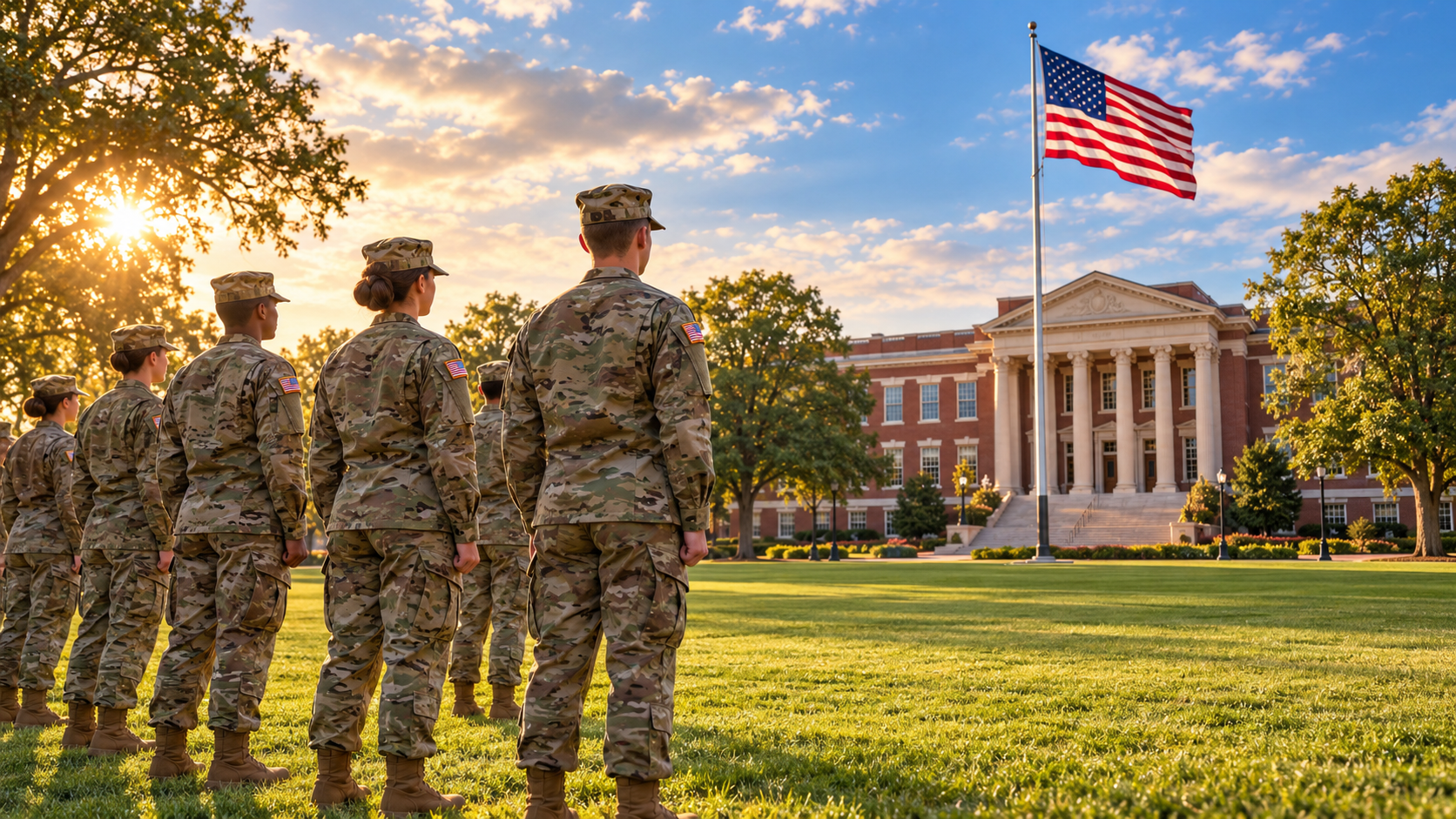
The officers who will lead in the 2040s are in high school right now. Where they are commissioned, and what they are taught before they swear the oath, will decide what kind of force they lead.
On September 30, speaking to active-duty E-6s and O-3s at Marine Corps Base Quantico, Secretary of War Pete Hegseth announced a program called America's Corps of Cadets. Five schools received a revived designation, Distinguished Military College: Louisiana State University, Liberty University, Tuskegee University, Hillsdale College, and Mississippi State University. The Department of War said the designation requires "exceptionally high standards of cadet discipline, tactical instruction, and military organization." Each school also receives "Honor School" status, which gives its cadets priority in officer commissioning.
The department's stated purpose is direct. It wants more officers "grounded in the Constitution, Western civilization, American heritage, and the warrior ethos at a time when many traditional commissioning sources have drifted from those foundations." The program builds on the existing corps of cadets at the six Senior Military Colleges: Texas A&M, Norwich, the Virginia Military Institute, The Citadel, Virginia Tech, and the University of North Georgia. Hegseth called the new designation a stepping stone toward Senior Military College status, should a school choose to pursue it. The implementing memo, as reported by The Dispatch in Columbus, starts implementation within 30 days and hands responsibility to the under secretary for personnel and readiness within 120 days. That first deadline arrives at the end of this month.
What does it take? LSU's commandant of cadets, retired Air Force Col. Joseph Musacchia, told Inside Higher Ed there are four criteria. A school must request the status. It must establish a four-year military or national security program. It must host a distinct, self-governed cadet corps led by an independent commandant who reports to the university president. And cadets must wear uniforms during all academic hours.
Mississippi State did not stumble into this. President Mark Keenum said the university was "established as a land-grant university and a military school," and that service is "part of our institutional DNA." MSU fields Army and Air Force Reserve Officer Training Corps (ROTC) programs. Keenum pointed to the long shadows of two alumni, Sen. John C. Stennis, who led the Senate Armed Services Committee for years, and Rep. G.V. "Sonny" Montgomery, whose name is on the G.I. Bill. Sen. Roger Wicker, who chairs the Armed Services Committee today, called it "terrific news" that creates new paths to a commission. Sid Salter, MSU's vice president for strategic communications, told The Dispatch the designation will let ROTC students "step to the head of the line" for commissioning.
The university's defense work goes beyond ROTC. On October 9, MSU announced it has been named Mississippi's America's Cutting Edge (ACE) Composites Hub, funded through the Department of War's Industrial Base Analysis and Sustainment program for three years, to train at least 750 people in aerospace composites manufacturing. The state has more than 48 aerospace manufacturers and parts suppliers that need those hands.
I have a particular reason to care how this is built. In 2026 I was Senior Advisor for Senior Service Colleges on the Secretary of War's war college task force. Our charge was to review how DEI was being stripped out of the war colleges' offices and coursework. That work happens at the top of the education pipeline, with officers who already have 15 or 20 years in uniform. A corps of cadets works at the other end, with 18-year-olds. If the foundation is sound, there is far less to repair later. I came into the Air Force at 17 as an enlisted bomb-disposal technician and retired as a colonel. Every rung of that ladder rested on what was taught at the first one.
Inside Higher Ed noted that Hegseth used the same Quantico speech to call Ivy League schools and most liberal arts colleges "anti-American, DEI-worshipping woke factories," and that the department did not say how it picked the five. The selection question has a simple answer worth stating: by Musacchia's account, schools must ask for the status and then meet a standard. The list also undercuts the charge that this is a partisan reward. It includes a historically Black university, Tuskegee, alongside two Christian colleges and two large public universities, LSU and Mississippi State.
Getting the designation is the easy part. Building a real corps is the work.
Mississippi State should meet the four criteria in full, not on paper. That means a commandant with genuine independence, uniforms that are worn every academic day, and a four-year program anchored in the Constitution, American military history, and leadership under pressure. The DEI bureaucracy that the Department of War spent this year removing from its own schools should have no role in the new corps from its first day.
The Board of Trustees of State Institutions of Higher Learning should support the effort without delay or added review. Other Mississippi universities with ROTC detachments should study the criteria. Hegseth said more partner schools will be announced soon.
Should Mississippi State decide to seek Senior Military College status, LSU's commandant says that step requires Congress. Senator Wicker and the Mississippi delegation should stand ready to move that legislation.
Starkville has sent officers to war for generations. With this designation, it can send more of them, better prepared, and Mississippi should see the job through.
