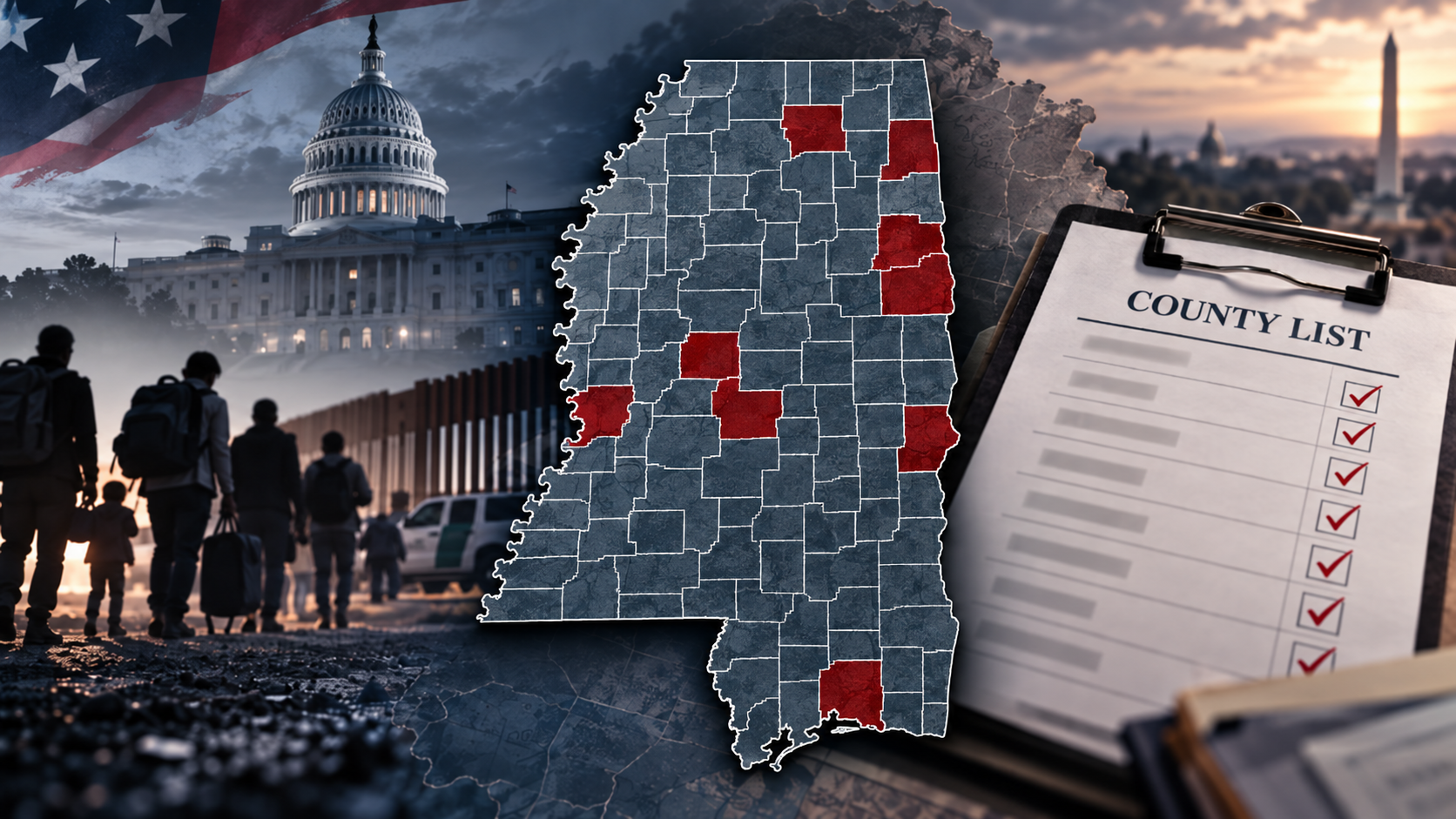
I live in Harrison County. This week I learned that a think tank in Washington had scored my county as a good place to put migrants. Nobody here was asked. Nobody in Rankin, Madison, Lee, Union, Lauderdale, Lowndes or Warren was asked either.
The reporting comes from Natalie Winters, who published her investigation on October 12. The think tank is the Niskanen Center. In November 2025 it released an immigration blueprint urging policymakers to "enable local governments and private entities to sponsor immigrants directly." The same document proposes state visa programs and "incentivizing new arrivals to stay in specific states and regions."
About two weeks later, on November 20, 2025, Niskanen published what it calls the Migration Match Index. Its baseline model sorts every county in America using five screens: unemployment below 4.3 percent, at least 14 percent of residents age 65 or older, rent under 30 percent of income, rental vacancies above 5 percent, and more job openings than unemployed workers. The report describes target communities as having an "aging, stagnant, or insufficient native labor supply." Among its uses, the authors list planning resettlement after "an influx of asylum seekers at the border" and a new structure for the federal refugee admissions program.
Eight Mississippi counties made the published list: Harrison, Lauderdale, Lee, Lowndes, Madison, Rankin, Union and Warren.
On October 13 I posted this on X: "Every one of these counties slated by the Democrats for more immigrants voted for Trump." The 2024 returns back that up. Union went for the President by about 70 points. Rankin by 47. Lee by 39. Harrison by 29. Lauderdale by 21. Madison by 17. Lowndes by 8. Warren by 4. Eight counties, eight Trump wins, some of them landslides.
Now follow the money. Winters reports that Niskanen's own funding disclosure lists $300,000 from George Soros's Open Society Foundations for immigration work, for a grant period running September 1, 2024, through February 27, 2026. Both documents came out inside that window. The same disclosure shows $400,000 from the Carnegie Corporation of New York and $100,000 from the Migration Policy Institute for immigration work. Winters also found that 96.5 percent of the selected counties nationwide are majority White.
This is not Niskanen's first venture into deciding where newcomers land. Its 2025 annual report says it "helped conceive and implement" Welcome Corps, the private refugee sponsorship program set up under President Biden. A related pilot, Welcome Corps at Work, which Niskanen reviewed in April 2025, ran refugee candidates through interviews with U.S. businesses; a job offer led to matching with a private sponsor group in the employer's community.
Fairness matters, so here are the limits. Winters herself notes that being on the list does not mean any county agreed to receive migrants or that any placements happened. Niskanen's annual report names no agency using the index to place people. The blueprint also backs stronger employment verification and enforcement. There is even a discrepancy in the numbers: Niskanen advertises 484 counties in 44 states, while its published lists contain 429 entries in 43.
None of that answers the real question. Who authorized a donor-funded shop in Washington to rank my neighbors' hometowns by how many apartments sit empty and how many grandparents live there?
The report answers that itself, in a way. It concedes there are "obvious, immeasurable social, cultural, and political variables" that affect whether migration will be welcomed. In Mississippi we measure the political variable every November. It is called an election, and these eight counties reported their results loud and clear.
I sit on the Harrison County Republican Executive Committee and serve as vice president of the Conservative Coalition of Mississippi. The people I work with are not against workers or job growth. They are against being managed. A plan that runs through "private entities" and "local governments" can move quickly, because private sponsors answer to donors, not voters. That is the design flaw. Consent becomes a box someone else checks.
Mississippians are entitled to plain answers to a few questions:
- Has Niskanen, or any group using its index, contacted any county board, city hall, employer or nonprofit in these eight counties?
- Has any Mississippi entity signed on, or been invited, to act as a private sponsor?
- Do any state agencies or economic development offices use the index or anything like it?
- If a sponsorship arrangement were proposed tomorrow, would the public hear about it before or after the fact?
Here are the steps that would settle it.
Supervisors in Harrison, Rankin, Madison, Lee, Union, Lauderdale, Lowndes and Warren counties: pass resolutions stating that no county resources will support any migrant sponsorship or resettlement arrangement without public notice, a public hearing and a roll-call vote of the board.
Speaker Jason White and Lieutenant Governor Delbert Hosemann: in the 2027 session, put that same standard into state law, so no city, county or state-funded entity can join a sponsorship scheme in private.
Congressman Mike Ezell: ask Niskanen, on the record, whether anyone has used its Mississippi rankings, and push for local government consent in any federal sponsorship program.
Governor Reeves: make clear that Mississippi's front door is not managed from a Washington spreadsheet.
These are our counties. Ask the people who live in them.
