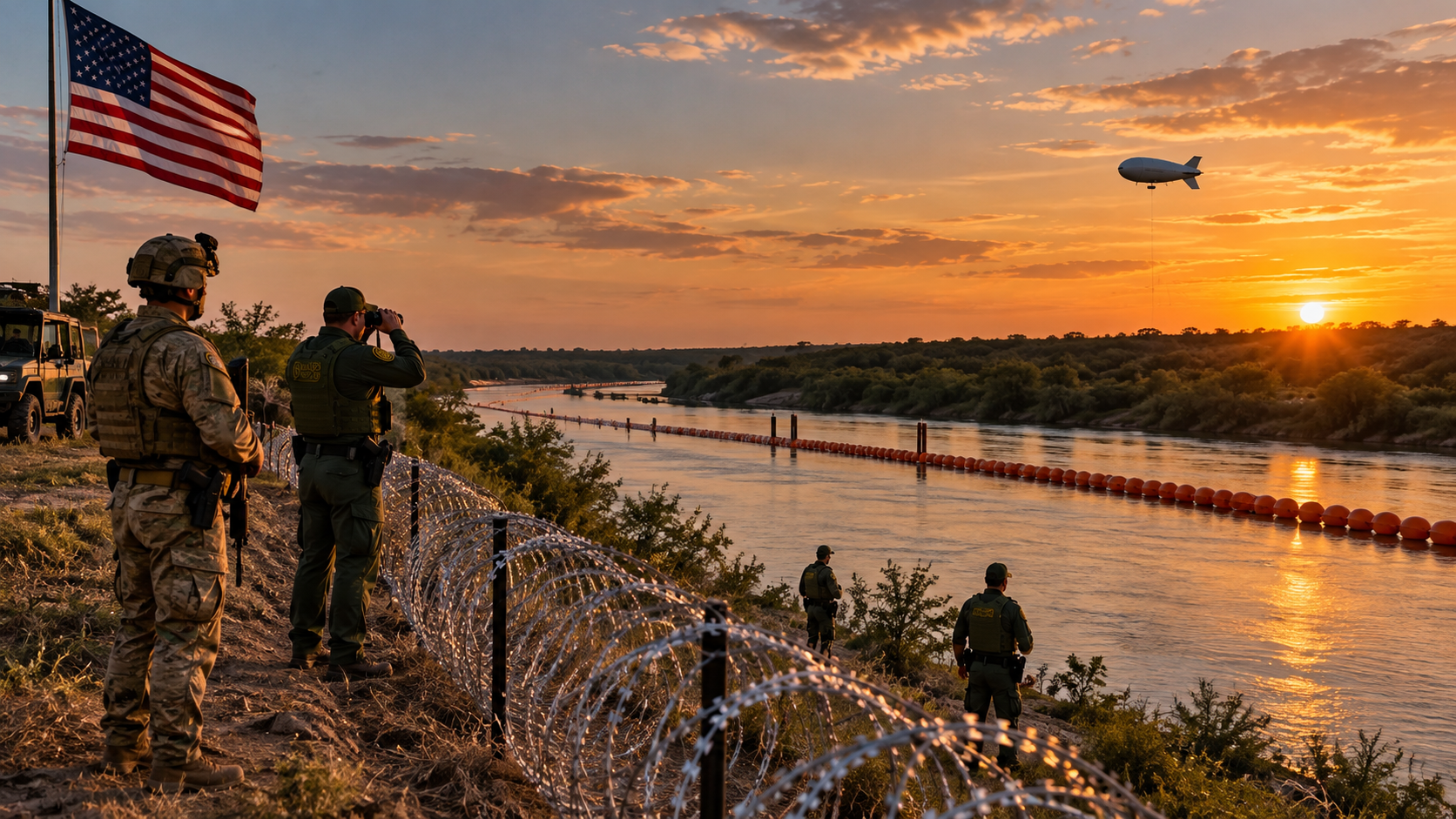
In 2021, Roma, Texas, became a symbol of a border that had stopped functioning. Thousands of families and unaccompanied children arrived each day seeking asylum, and rafts crowded a stretch of river barely a football field wide.
Visit the same spot this month and the river is quiet. That is no accident. It is the result of policy, manpower and persistence, and the Army is now reinforcing it.
The Associated Press reported from Roma on October 13 that the Army has been inviting reporters to the Rio Grande Valley while it moves hundreds more soldiers into the region, drawn from the roughly 8,000 troops it already commands along the 2,000-mile southern border. Joint Task Force-Southern Border announced the effort, Operation Unified Resolve, on October 2 as part of the broader Operation Ardent Vanguard. Its stated aims are more patrol capacity, more monitoring and detection, and better security at critical locations, all in support of the Department of Homeland Security and Customs and Border Protection.
The trigger was not hypothetical. U.S. officials cited signs of elevated cartel activity. Late last month, while stopping a boat on the Rio Grande near Garceno, Texas, the Coast Guard took gunfire from the Mexican side and returned fire. No Americans were hurt. Cmdr. Jeff Miller said only that his crews work in "a very challenging environment" and may use force in self-defense.
When armed men shoot at American servicemembers from across a river, the right response is more presence, not less. Washington answered by reinforcing the line, and Mexico followed. Under pressure from President Trump, the Sheinbaum government this month sent 500 National Guard troops and military officers into Tamaulipas, the state directly across from Roma, in a coordinated effort against drug and human trafficking. It brought two UH-60 helicopters, drones and counter-drone gear.
The results are on paper. The Department of Homeland Security reported 8,870 Border Patrol apprehensions along the southwest border in August, 94 percent below the monthly average of the Biden years and 97 percent below the December 2023 peak. DHS says the Border Patrol has gone 16 straight months without releasing a single illegal crosser into the country.
Look at what the soldiers in Roma are working with: strung-together buoys the size of hay bales, concertina wire along the bank, a surveillance blimp overhead, and a river island cleared of the brush that once hid people trying to cross. The Army and Coast Guard have jammed, captured or shot down many of the cartel drones used to scout the border and ferry drugs, some of them with a laser.
Maj. Gen. Curtis Taylor, who commands the southern border task force, described the mission as "dismantling this marketplace of human trafficking." He added: "An added benefit of that is there's an awful lot of drugs moving with that human trafficking."
Joel Garcia, the Border Patrol's acting deputy chief patrol agent for the Rio Grande Valley, gave the best summary of the whole effort: "Border security, when done right, if we have truly secured the line, should be boring. It should look as if no one is crossing and nothing is happening."
That is the standard. A dull afternoon on the river is a victory, not evidence the troops are wasting their time.
Some academics see it differently. University of San Diego professor David Shirk told the AP the administration wants to remind voters how aggressive it has been, and argued most trafficking now runs through ports of entry. Syracuse professor Dessa Bergen-Cico pointed to low street prices for fentanyl and cocaine. The AP framed the surge as a question of politics weeks before the midterms.
Those objections miss how deterrence works. Smugglers go where resistance is weakest. Close the gaps between the ports, and the pressure shifts to the ports. That is an argument to keep building at the checkpoints, with more scanners and inspectors, not to pull soldiers off a riverbank where the Coast Guard just took fire. Fentanyl moving through cargo lanes does not make human smuggling across the river acceptable. Both have to be stopped.
The timing complaint also cuts the other way. The Coast Guard took fire in late September. Troops repositioned in early October. That is a response to an attack, not a campaign calendar. If anything, the midterm framing tells you how few arguments remain against the policy itself. Even the AP notes that border security remains a relative bright spot in the President's polling, with about half of Americans approving.
Border Patrol remains the lead agency, and that is as it should be. The military's role is support: aerial surveillance, patrols on the river, and the deterrent effect of a visible, armed presence. It is the kind of limited, objective-driven mission conservatives have long favored.
Lawmakers should fund the operation without games. The Department of War should keep the counter-drone effort growing; as one Army officer in Roma put it, a drone crossing in the middle of the night is "a true threat to any soldier on the ground." And DHS should keep publishing monthly numbers so Americans can judge the results for themselves.
Strength on the line produced the quiet. Keep it boring.
