The Data Republican Series, Installment 32, built on the research of DataRepublican ([@DataRepublican](https://x.com/DataRepublican)) and her Democracy Files partners [@SKDoubleDub33](https://x.com/SKDoubleDub33) and [@IamLisaLogan](https://x.com/IamLisaLogan). Previous: [Installment 31](https://www.robmaness.com/2026/11/datarepublican-the-democracy-files-network-now-has-a-seat-at-the-governors-table/). New readers can begin at [Part 1, "The Plan"](https://x.com/datarepublican/status/2112157558765203878).
A scale for grading speech is only a theory until someone hands it to whoever chairs the meeting.
Installment 31 followed SKDoubleDub33's thread on the Dignity Index into Oklahoma's executive branch and the National Governors Association. This week I followed it into a place every Mississippian can walk into on a Tuesday night: the room where your city council meets.
A note on the series first. DataRepublican's numbered Democracy Files documents are still on pause. On Nov. 20 she wrote that she would return to the series soon, and nothing new in it went up on her account between Sunday morning and early Monday. Her partner's thread kept going in the replies, though, and that is where this week's lead came from.
What the readers found
On Saturday a reader, Priscilla West, answered SKDoubleDub33's post with a screenshot of what she called a new Dignity Index "AI speech-grading tool available 'FREE for a limited time!'" Then she asked: "How long before it is built into web browsers, word processing software, and social media platforms?"
SKDoubleDub33 answered her Sunday morning. "That's not the worst of it," he wrote. "It will end up being part of your digital ID. When the commies start distributing resources 'equitably,' your political speech will definitely factor in to what you receive." He added that "a lot of this stuff" is already reaching children at school. That is his warning and his read of where this leads, and he says so plainly.
Her question about browsers already has an answer, and it comes from the product's own website.
The tool
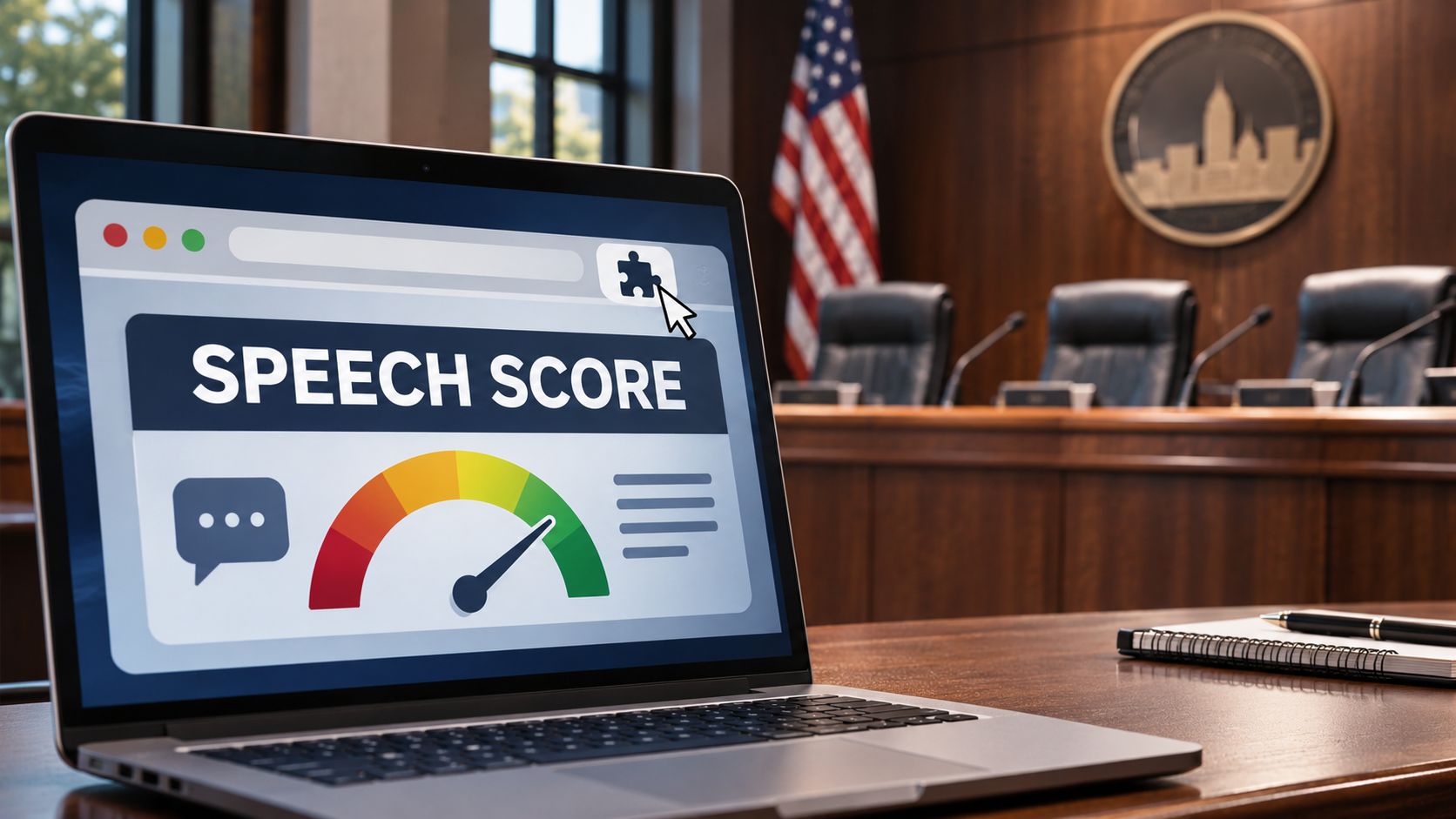
Dignity Coach, billed as coming "from the team behind the Dignity Index," invites users to "check your words and understand your score." Paste in a text message, a comment or a line from a speech, and it returns a score from ONE to EIGHT, the phrases that "lift or lower the score," and rewritten versions at "higher dignity levels."
Then there is the browser extension. "Get a live score right where you write, in Gmail, social media, and more," the site says. Click the badge and "one click swaps in the version you choose." Accounts are free with unlimited checks through Dec. 31, 2026, during what the site calls a "soft launch." Paid memberships start Jan. 1, 2027. The copyright line reads Project UNITE, Inc. and Dignity.Us.
So Priscilla West's question about web browsers was not a hypothetical. The extension is live.
The resolutions
Dignity.Us also runs a "Dignity Politics" program. Its public toolkit offers model resolutions written for "governing bodies."
One, titled "FIVE and UP," commits a body "to conduct all official meetings with interactions that fall at Level FIVE or higher on the Dignity Index." Another says "those participating in proceedings and interactions with this body" will "be held to similar standards of discourse." In a city council, the people participating include the citizens who come to the microphone during public comment.
A companion guide for public meetings says elected officials "must safeguard free speech," and much of its advice is ordinary courtesy: arrive early, listen, take notes. It also tells boards to "consider implementing guidelines that prohibit applause, or other audible or visual displays of agreement/disagreement."
The program's page says Dignity.Us works with officials to reach "K-12 public education" and higher education in their states. Its higher-education page asks university presidents to take the pledge, sit through a 90-minute training and write "a campus implementation plan," and it lists a "dignity code of conduct" as coming soon. The site's menu also lists a "Certified District Trainer" program.
Why this belongs in the Democracy Files
Nobody who grew up here needs a scorecard to treat a neighbor decently. That is not what this is about.
What matters is who owns the ruler. When a public body adopts a private group's rating system as the standard for its own meetings, its authors get a say in what counts as acceptable speech in a government room. When the same group sells an extension that grades and rewrites what citizens type, and paid memberships begin Jan. 1, the speech standard and the revenue stream share an owner. When parents and taxpayers walk into public comment, they should be judged by the law and the rules their own elected board adopted in public, not by a scale licensed from outside.
DataRepublican's documents have mapped a network that treats normal political conflict as an emergency to be managed. That is the Illegitimacy Playbook: call the argument itself the danger, then offer a process run by the network as the cure. A speech score adopted by a city council fits the pattern. The pattern is my analysis. Every quotation above is taken from the groups' own pages, and the links are below so you can read them yourself.
Her credibility rests on that habit. She publishes the receipts, labels her conclusions, and invites readers to check them. Her partners do the same, and this week a reader checked, and the trail held.
What Mississippi's boards should do now
- Every city council, board of supervisors and school board in Mississippi should state on the record whether it has adopted a Dignity Index resolution or meeting guideline, and decline to adopt one. Rules for public comment should be written by the board in public, applied equally, and based on law.
- School superintendents and the State Department of Education should tell parents whether any district has a Dignity.Us "Certified District Trainer" or uses Dignity Index lessons, and who paid for them.
- The IHL Board of Trustees should ask each university president whether he or she has signed the presidential pledge or adopted a campus implementation plan.
- Congress, along with the agencies' watchdogs, should search federal award data for Project UNITE and Dignity.Us. Taxpayer money should not be underwriting a speech-scoring product. If any is, end it.
- Citizens should ask the question at their next public comment period. That is what the microphone is for.
My anti-fraud pledge and my work on nonprofit transparency come down to one rule: when an outside organization shapes how public business is done, the public gets to see the paperwork. Ask your board before it votes, not after.
Sources
- SKDoubleDub33 on X, on Gov. Stitt and the Dignity Pledge (Nov. 21, 2026):
- Priscilla West on X, reply on the Dignity Index scoring tool (Nov. 21, 2026, 9:48 a.m. CST):
- SKDoubleDub33 on X, reply on digital ID and schools (Nov. 22, 2026, 6:57 a.m. CST):
- DataRepublican on X, on pausing the series (Nov. 20, 2026):
- Dignity Coach (Project UNITE, Inc. / Dignity.Us), product page, viewed Nov. 23, 2026: https://www.dignitycoach.us
- Dignity.Us home page, viewed Nov. 23, 2026: https://www.dignity.us
- Dignity.Us, Dignity Politics program and toolkit: https://www.dignity.us/dignitypolitics
- Dignity.Us, "SAMPLE TWO - FIVE and UP: Resolution to Uphold Dignified Discourse in Meetings" (PDF): https://www.dignity.us/s/SAMPLE-TWO-FIVE-and-UP.pdf
- Dignity.Us, "SAMPLE ONE - Formal: Resolution to Promote Dignified Discourse and Productive Communication" (PDF): https://www.dignity.us/s/Sample-1-Formal-Politics.pdf
- Dignity.Us, "Considerations for Dignity-Centered Public Meetings" (PDF): https://www.dignity.us/s/Considerations-for-Dignity-Centered-Public-Meetings.pdf
- Dignity.Us, Higher Education program: https://www.dignity.us/higher-education
- Installment 31, robmaness.com: https://www.robmaness.com/2026/11/datarepublican-the-democracy-files-network-now-has-a-seat-at-the-governors-table/
- DataRepublican, Part 1 of the series:
- @DataRepublican:
- @SKDoubleDub33:
- @IamLisaLogan:
